 Stakely
Value and Momentum: Rivals or Partners?
Factor Investing·October 21, 2026
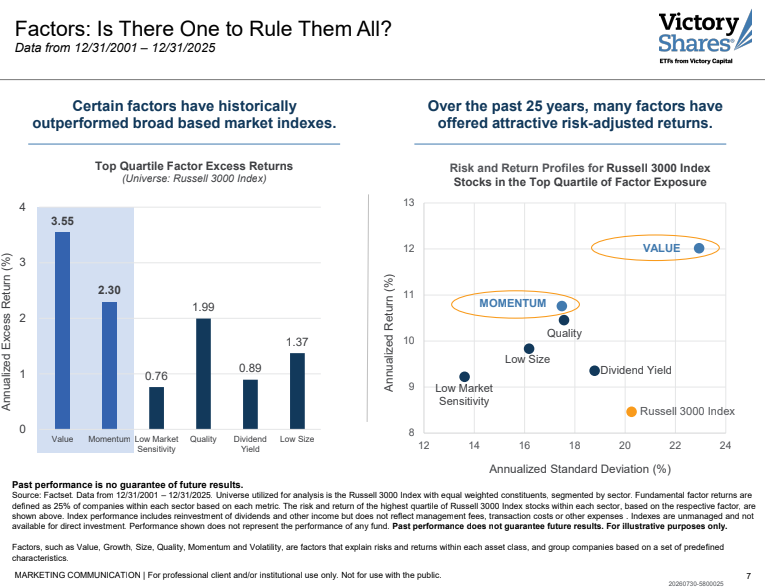
Investors often treat value and momentum as opposing camps, one buying what looks cheap and the other chasing what is already rising. A recent episode of the Talk Your Book podcast makes the case that the two can complement each other, and that a blend may hold up better than either style on its own.
The core argument is about diversification of return sources. Value can help when trends fade, and momentum can carry a portfolio through stretches when cheap stocks stay cheap. Combining them spreads a portfolio's bets across two different drivers instead of relying on one style's timing.
Turnover is the practical obstacle. A pure momentum approach that reshuffles into the strongest performers every period can generate heavy trading costs and tax bills. The episode points to buffered rebalancing as a way to ease that problem. Rather than selling a holding the moment it slips in the rankings, a manager keeps it until it falls meaningfully out of the leading group. That looser rule keeps turnover lower while still capturing most of the trend.
The discussion also touches on a shift in the current market. Surging earnings from AI and semiconductor companies have pushed many former momentum leaders into a different profile, which can make them harder to classify under a standard factor screen. For investors, that means the label attached to a stock can change over time, and periodic reviews of what a holding is actually being rewarded for matter as much as the original screen.
The broader takeaway is that factor labels are useful tools rather than fixed identities. A rules-based process that accounts for both value and momentum, with trading discipline built in, may serve investors better than strict loyalty to one style. Results will still depend on implementation and on market conditions, which can change quickly.
Reporting based on an external source.