 Stakely
Stop Chasing Salary Multiples and Measure Your Retirement Spending Instead
Retirement Planning·November 17, 2026
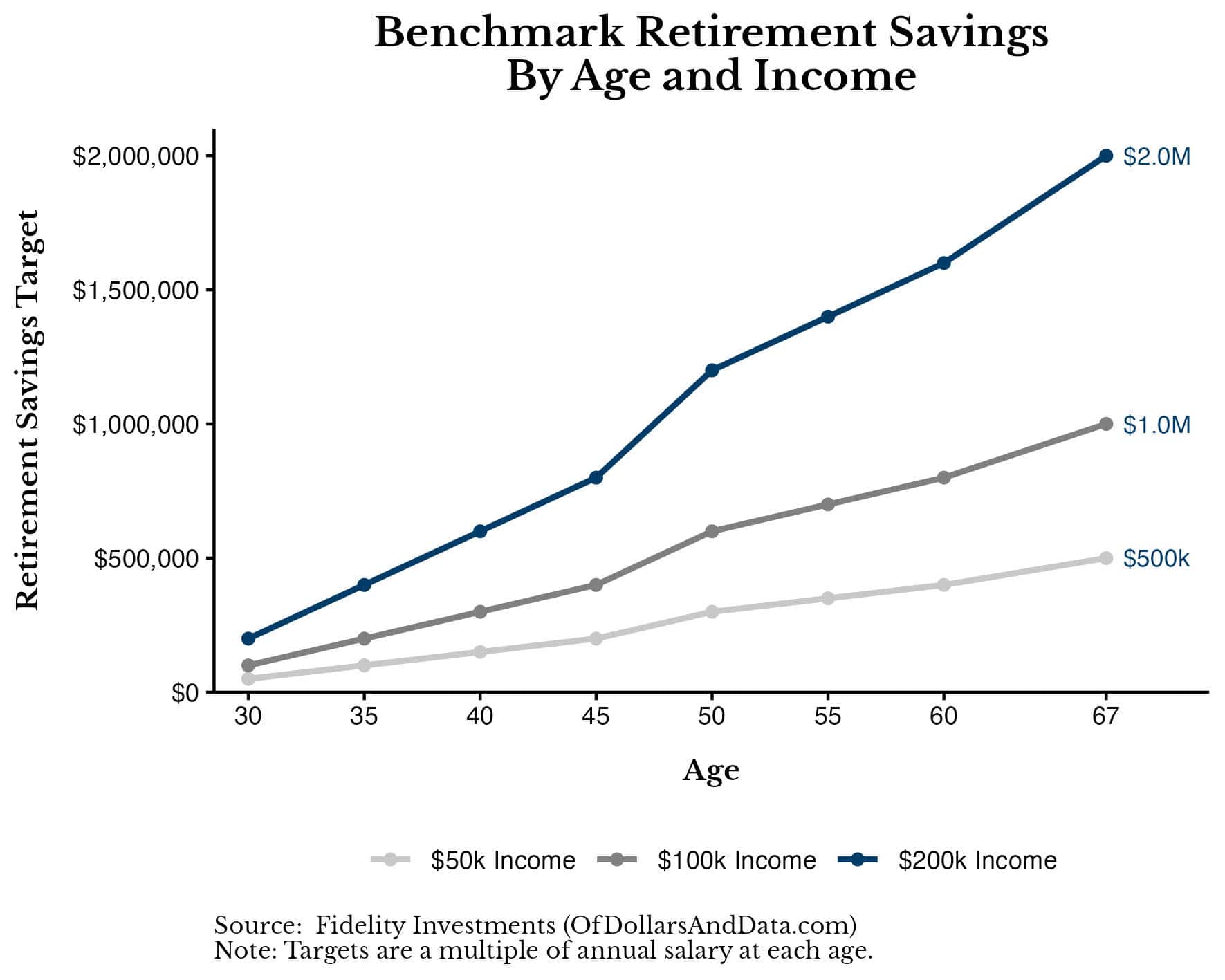
Anyone who has wondered whether they are saving enough for retirement has likely run into the same rule of thumb: a multiple of your salary, tied to your age. One widely cited version from Fidelity suggests having 1x your income saved by 30, 3x by 40, 6x by 50, 8x by 60, and 10x by 67. Someone earning $100,000 would be expected to hold $400,000 by 45. The guideline is easy to remember, but it breaks down quickly. Incomes swing with bonuses, layoffs, career changes, and raises, and a rule that doubles your savings target when your pay doubles does not reflect what you will actually need to live on.
The data makes the problem harder to ignore. The median retirement account balance across all U.S. households was about $5,000 in the 2025 Survey of Consumer Finances. Part of that reflects age. The youngest households have had little time to save, and the oldest often had limited access to workplace plans during their working years and have since been drawing down what they had. The larger factor is access. At least 35% of households in every age bracket have no retirement account at all, largely because many lower-paid jobs do not offer one. Among households that do have accounts, the median rises to about $106,000, and for those aged 60 to 64 it reaches roughly $252,000. Even that is below what the income multiples call for. Depending on age, only about 3% to 9% of households meet the benchmarks.
Those figures do not point to a single cause. Social Security replaces a larger share of income for lower earners than for higher earners, so applying the same income multiple to everyone ignores that difference. The rules also skip the variable that matters most: spending. Two households earning $100,000 can end up in very different places. If one saves $50,000 and spends $50,000 while the other saves $20,000 and spends $80,000, and both want to keep their lifestyle in retirement, the first needs far less saved. A higher savings rate both shrinks the nest egg you need and gets you there sooner.
A spending-based approach starts by estimating your annual retirement spending in today's dollars. Subtract any guaranteed income you expect, such as Social Security or a pension, to find the uncovered amount your savings must fund. Multiply that gap by 25, which corresponds to a 4% initial withdrawal rate, to get your total future need. Then count the years until you plan to retire, and divide the future need by 1.05 raised to that number of years. The division reflects an assumption that your investments grow about 5% a year above inflation until you retire.
One illustration from the source helps show how this works. The author estimated $150,000 of annual retirement spending and expected about $36,000 a year from Social Security, which was already reduced by 25% as a cushion. That left $114,000 to cover. Multiplying by 25 produces a future need of $2.85 million. With 31 years until a full retirement age of 67, the target today comes to about $628,000.
Once you have a current target, compare it with what you have saved across all accounts. If your balance already exceeds it, growth at around 5% a year should carry you to your future need without new contributions, which is the basic idea behind Coast FIRE. If you fall short, you can save more, plan to spend less in retirement, or do some of both. The gap is usually widest early in a career and should narrow over time as you save and invest. Recalculating every few years captures changes in spending, family circumstances, and expected Social Security benefits.
The formula is only as reliable as its inputs. A 5% real return and a 4% withdrawal rate are assumptions, not guarantees, and the calculation does not account for taxes, market downturns early in retirement, or unexpected expenses. Its real value is that the target belongs to you. Comparing your balance with averages or with what friends have saved says little about your own plan, while your spending and timeline say a great deal. Running your own numbers is more useful than any published benchmark.
Reporting based on an external source.