 Stakely
Most Stocks Are Losers: Why a Few Winners Drive Market Returns
Investing Basics·October 6, 2026
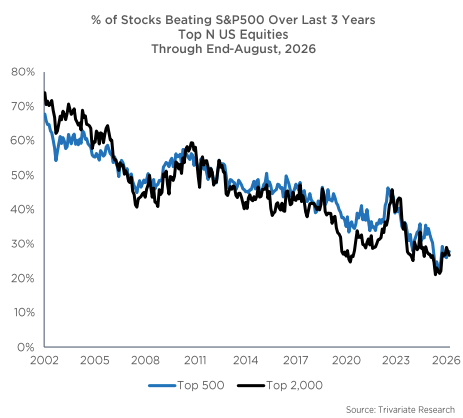
The stock market rewards patience, but it is far less generous to individual stock pickers than most investors assume. Research on long-run equity returns keeps pointing to the same uncomfortable fact: the typical stock trails the index, and often does worse than that.
The reason is simple math. Market returns are not spread evenly across companies. A small slice of businesses delivers enormous gains over many years, while the majority produce modest returns, lag Treasury bills, or lose money outright. Index results look healthy because those few outsized winners pull the average up.
This is a skewed distribution, and skew changes how investing works. A stock can only fall 100 percent, but there is no cap on how high a great one can climb. A single holding that multiplies many times over can erase the losses from dozens of mediocre picks. That is why the index is hard to beat. To do it, you need to own the rare standouts, and you need to hold them long enough to capture the payoff.
For investors, the practical consequences are clear. First, concentrated portfolios carry a real risk of missing the winners entirely. If you hold ten or twenty names, the odds that none of them is among the market's big long-term performers are meaningful, even if you are a careful analyst. Second, broad index funds work because they guarantee you own the winners without having to identify them in advance. You also own the losers, but the losses are limited while the gains are not.
Third, it helps to be honest about hindsight. The best-performing stocks of past decades often looked expensive, risky, or unloved along the way. Many went through deep drawdowns before their runs. Spotting them early is hard, and sticking with them through the volatility is harder still.
None of this means that stock picking is pointless. Some investors do generate excess returns, and there are sensible reasons to hold individual companies, from tax management to personal conviction. But the base rate matters. Anyone building a portfolio of single stocks is taking on a bet against the odds, and should size that bet accordingly.
A reasonable approach for most people is to anchor the portfolio in low-cost diversified funds and treat any individual stock positions as a smaller satellite. That keeps the engine of long-term returns running while limiting the damage if a favorite pick turns out to be one of the many losers.
The takeaway is not that markets are dull or that skill is useless. It is that success in equities depends on a handful of exceptional outcomes, and diversification is the most reliable way to make sure you are on the right side of them.
Reporting based on an external source.